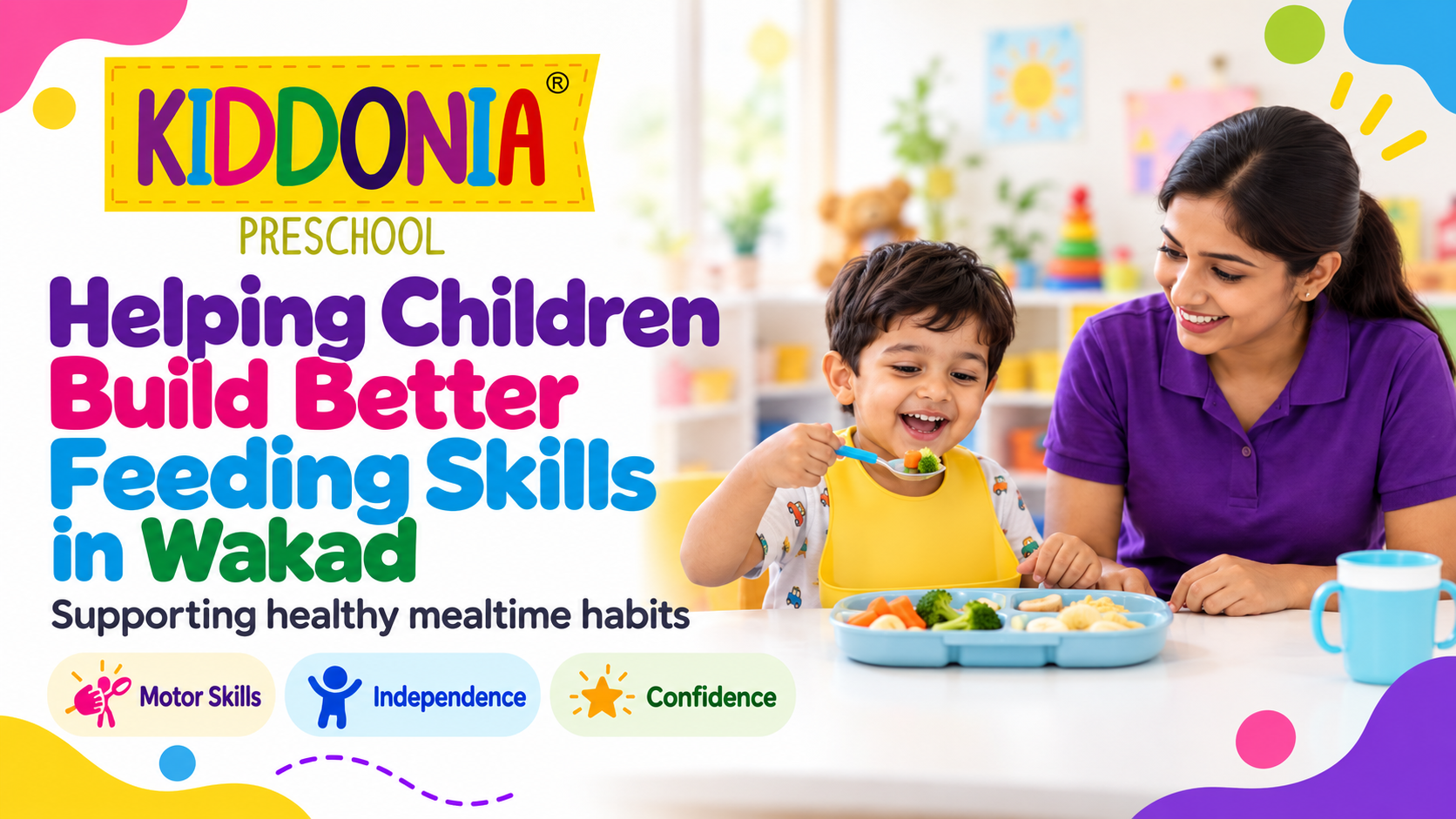
Learn how preschool routines can help children develop better Feeding Skills, independence and mealtime skills. Practical tips for parents in Preschool in Wakad. Mealtimes are an important part of early childhood, but they do not always go smoothly. Some children are selective about food, take a long time to finish meals, avoid certain textures, or become uncomfortable when trying something unfamiliar. For parents, these everyday situations can sometimes become stressful.
The preschool years are also a time when children are learning independence. Sitting at the table, holding a spoon, drinking from a cup, trying new foods and communicating when they are full are all skills that develop gradually.
Table of Contents
A supportive preschool environment can give children opportunities to practise these skills naturally. Along with learning through play, children can develop confidence around routines such as washing hands, sitting for meals and participating in snack time.
For families looking for a Preschool in Wakad, it is worth considering not only academics and activities, but also how the preschool supports everyday habits and independence.
Why Feeding Skills Matter During the Preschool in Wakad Years
Eating is more than simply finishing a meal. Young children are developing several physical, social and behavioural skills at the same time.
During preschool years, children may gradually learn to:
- Sit comfortably during meals
- Use spoons and other age-appropriate utensils
- Drink independently from a cup
- Chew and manage different food textures
- Recognise hunger and fullness
- Try unfamiliar foods without pressure
- Follow simple mealtime routines
- Communicate their preferences
- Stay involved in a shared meal setting
These abilities develop at different speeds. One child may happily try new foods while another may need more time. Comparing children can create unnecessary pressure, so patience and consistency are usually more helpful.
How Preschool Routines Can Support Better Feeding Skills Habits
Children often respond well when routines are predictable. A consistent sequence such as washing hands, sitting down, eating and cleaning up can help children understand what happens next.
A Play School in Wakad that includes age-appropriate routines can provide opportunities for children to practise these habits alongside their peers.
For example, a preschool snack routine might involve:
- Washing hands before eating.
- Sitting in a designated eating area.
- Opening or handling food with age-appropriate support.
- Eating at a comfortable pace.
- Putting away containers after finishing.
- Washing hands or cleaning the eating area afterward.
The goal is not to make every child follow an identical eating pattern. Instead, routines can help children understand mealtime expectations while giving them room to develop independence.
What Can Parents Do When a Child Is a Picky Eater?
Selective eating is common during early childhood. A child may suddenly reject foods they previously enjoyed or prefer only a small number of familiar options.
Parents can try a few simple approaches at home.
Offer Variety Without Pressure
Continue offering different foods, but avoid turning every meal into a battle. A child may need repeated opportunities to become comfortable with a new food.
Include Familiar Foods
When introducing something new, placing it alongside a food the child already accepts can make the meal feel less unfamiliar.
Let Children Participate
Simple tasks such as washing vegetables, arranging fruit on a plate or choosing between two healthy snack options can make children more interested in food.
Keep Mealtimes Calm
Pressure, arguments and repeated demands to finish everything can make mealtimes stressful. A calm environment can help children pay attention to eating rather than the conflict around it.
Give Children Age-Appropriate Independence
Allowing a child to hold a spoon, pour water with help or decide which of two offered foods they want can support confidence.
If feeding difficulties are persistent, severe or accompanied by concerns about growth, swallowing, choking or nutritional intake, parents should discuss them with an appropriate healthcare professional.
The Role of Early Childhood Education in Building Independence
Early childhood education is not limited to letters, numbers and classroom activities. Young children are also learning how to manage everyday situations.
A good preschool environment gives children opportunities to practise skills such as:
- Following simple routines
- Waiting for their turn
- Communicating with adults and peers
- Cleaning up after activities
- Managing personal belongings
- Developing self-help skills
- Participating in group activities
These experiences can indirectly support a child’s confidence during mealtimes too.
When choosing Early Childhood Education in Wakad, parents can therefore look beyond the activity list. It can be useful to understand how the school handles daily routines, snack times, hygiene and age-appropriate independence.
What Should Parents Look for in a Preschool?
Every family has different priorities, but a few practical questions can help when comparing preschools.
1. Are Daily Routines Clearly Structured?
Children generally benefit from knowing what comes next. Ask about arrival routines, snack or lunch times, activity transitions and rest periods.
2. How Are Mealtimes Managed?
If meals or snacks are part of the programme, ask how children are supported. Are they encouraged to eat independently? Is adult assistance available when required?
3. Is Hygiene Part of the Routine?
Handwashing before eating and maintaining a clean eating environment are simple habits that children can learn through regular practice.
4. Are Children Given Age-Appropriate Choices?
Small choices can help children develop independence without making the environment overwhelming.
5. Is There Communication With Parents?
Parents should be able to understand how their child is adjusting to routines. Communication can be particularly useful when a child has specific eating habits or difficulties.
Families considering Preschool and Daycare in Wakad may also want to ask how these routines are maintained throughout the day, especially when children spend longer hours at the centre.
Preschool and Daycare: Why the Daily Routine Matters
For children attending daycare for several hours, everyday routines become an important part of their experience.
A well-planned Daycare in Wakad can provide consistent opportunities for children to practise self-help skills throughout the day. This may include eating, washing hands, organising belongings, resting and participating in activities.
Parents can ask whether the daycare follows a predictable daily schedule and how individual needs are communicated to families.
The objective should be to create a comfortable environment where children gradually learn to do more things independently, rather than expecting them to master every skill immediately.
Making Mealtimes More Positive at Home
Preschool routines work best when parents and educators communicate with each other. Children benefit when expectations are reasonably consistent across environments.
At home, parents can support this by creating simple routines.
For example, instead of repeatedly reminding a child to eat, parents can establish a regular meal setting where the child sits at the table, has access to suitable food and is given enough time to eat.
You can also involve children in small parts of meal preparation. A preschooler might help wash fruit, choose between two vegetables or place napkins on the table. These small activities can make food a familiar part of everyday life rather than something associated only with pressure.
Trice can also be a useful reference point for parents who are thinking about how children’s everyday routines, independence and early learning environment fit together.
When Should Parents Seek Professional Advice?
Not every feeding challenge requires professional intervention. Children can have changing preferences and phases of selective eating.
However, parents should consider seeking professional advice if they notice ongoing concerns such as:
- Frequent choking or coughing while eating
- Significant difficulty chewing or swallowing
- Very limited food choices over an extended period
- Strong distress around eating
- Concerns about adequate nutrition
- Difficulty progressing to age-appropriate textures
- Concerns about growth or development
A paediatrician, registered dietitian, speech-language professional or occupational therapist may be appropriate depending on the concern.
The important point is not to assume that every feeding difficulty is simply “picky eating.”
Choosing a Preschool With Everyday Development in Mind
The preschool years are about much more than classroom learning. Children are developing communication, confidence, social skills and independence through everyday experiences.
Feeding skills are one small but meaningful part of that development. Simple routines, patient adults and opportunities to practise self-help skills can help children become more comfortable with everyday tasks.
For parents comparing the Best Preschool in Wakad, the right choice may be one that looks at the child’s overall experience rather than focusing only on academics. Ask questions, understand the daily routine and consider whether the environment feels appropriate for your child’s age and personality.
A positive early learning environment can give children the time and space they need to learn at their own pace, including when it comes to something as ordinary and important as mealtimes.
Frequently Asked Questions
Is picky eating normal in preschool children?
Selective eating can occur during the preschool years as children’s preferences and comfort with different foods change. A calm routine and repeated exposure can help, but persistent or serious feeding concerns should be discussed with a healthcare professional.
Can preschool help children become more independent during meals?
Yes. Simple routines such as handwashing, sitting for meals, using age-appropriate utensils and cleaning up can give children regular opportunities to practise independence.
What should I look for when choosing a Preschool in Wakad?
Look at the overall learning environment, teacher interaction, safety, hygiene, daily routine, communication with parents and how the preschool supports children’s age-appropriate independence.
Is daycare useful for children who need a consistent routine?
A consistent daycare routine can help children become familiar with daily activities such as meals, rest, play and hygiene. Parents should understand the centre’s schedule and how individual needs are handled.
Should I force my child to finish their food?
It is generally better to avoid turning meals into a power struggle. Children can be encouraged to try foods while being given an appropriate level of independence. If there are ongoing concerns about eating, consult a qualified professional.