Explore preschool Diwali celebrations in Wakad, Pune: play-based learning, diya painting, rangoli, safe festive activities and tips for parents.
Table of Contents
Why Preschool Diwali Celebrations Matters in Early Childhood Education
Ask a four-year-old what Diwali means and you’ll rarely hear about the calendar. You’ll hear about lights, new clothes, sweets, rangoli on the doorstep and the very serious business of lighting a sparkler with Papa. That’s exactly why preschool Diwali celebrations deserve a proper place in early childhood education. For a small child, a festival is the most vivid lesson in culture she’ll ever get, because it arrives through every sense at once. This year the festival fell on Sunday, 8 November, and the five-day celebration ran from 6 to 10 November, so classrooms across Pune have only just packed away their diyas and glitter. The story at the heart of it is simple enough for a toddler: the victory of light over darkness. Little ones grasp that idea instantly, because most of them have felt the relief of a night-light switching on. A thoughtful play school in Wakad doesn’t treat Diwali as a day off or a decoration project. It treats it as a rich, ready-made theme that threads through art, language, maths, movement and manners, all inside the warm, hands-on style that young children learn best from.
What Children Learn From Preschool Diwali Celebrations
Cultural Awareness and Belonging
Every child wants to feel she belongs somewhere. When her classroom paints diyas, hums festive songs and talks about family traditions, she learns that her home culture is valued in the big, wide world outside it. That quiet message builds identity and confidence far faster than any lecture could. In a city like Pune, where classrooms bring together families from many backgrounds, Diwali also becomes a doorway to curiosity about others. One child explains rangoli, another mentions her own festival of lights, a third asks why the diya has a wick. Suddenly the room is full of respectful questions, which is what we hope grown-up citizens will ask, too. Educators can gently widen the circle by noting that other communities celebrate lights at different times of year. Kiddonia’s own materials describe a strong balance between academics, activities and festivals, and parents mention that balance in their reviews. Festivals, handled with warmth rather than pressure, remind children that learning is also about people, stories and shared joy, not only letters and numbers.
Cognitive and Language Growth
Behind the glitter, there’s plenty of brain work going on. Counting out twelve diyas, sorting them by size, spotting the repeating pattern in a rangoli border, describing how the clay feels when it’s wet: that’s early maths, science and vocabulary happening before snack time. Research backs the approach. A 2026 scoping review of more than 50 studies found that play-based learning supports cognitive skills, executive function, literacy, mathematics and social-emotional development. Festivals simply give those skills a joyful context, so words like “bright”, “flicker”, “spiral” and “festival” stick because they’re attached to something exciting. Language grows through repetition, too. Children who sing the same Diwali rhyme for a week learn rhythm, rhyme and recall without noticing. Teachers can build on this with open questions such as “what happens when we add more yellow?” or “what do you think the diya needs?” Open questions make a child think and speak in full thoughts, which is the very heart of play-based learning and a lasting habit worth building from age two.
Social and Emotional Skills
Picture ten three-year-olds around one tray of coloured powder, each wanting the red. Welcome to your first lesson in patience, turn-taking and sharing, with no worksheet in sight. Festival activities are naturally cooperative, since a rangoli is bigger than any single child and a class lantern needs many hands. Children learn to wait, to ask politely, to admire a friend’s work and to cope when their own paper diya tears. UNICEF’s June 2026 report on play describes it as a safe training ground where children can safely face defeat and practise emotions they’ll meet again later in life. Festivals add something extra, which is anticipation. Counting down the days, preparing a surprise for parents and finally performing a small song builds delayed gratification and pride. For shy children, a group performance can feel less scary than speaking alone, because the whole class carries the song together. These child development activities show up months later as kinder, more confident behaviour in the playground.
Preschool Activities for Kids: Diwali Ideas That Work
Diya Painting and Rangoli Art
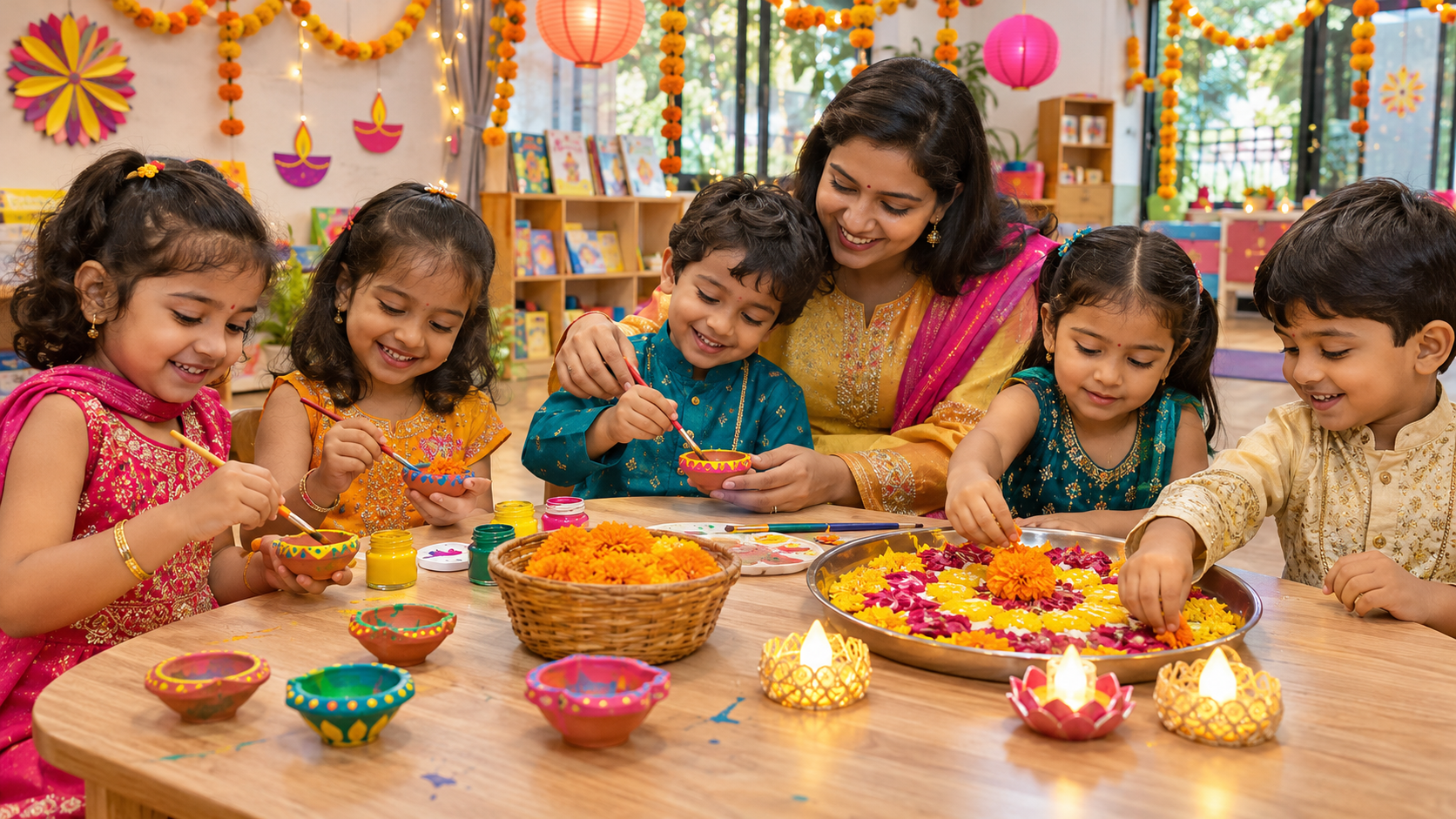
Nothing says Diwali like a doorstep rangoli, and nothing says preschool like a table covered in paint. Children can decorate clay or paper diyas with brushes, fingers and sponges, then arrange them into a cheerful pattern. For rangoli, skip the tricky geometry. Offer coloured rice, flower petals, dyed sand or chalk, and let each child fill a section of a large shared design. The magic lies in the process, so please resist the urge to “fix” a lopsided petal. A wobbly flower made by a three-year-old teaches more than a perfect one made by an adult. This sort of creative learning for kids builds fine motor control, colour recognition, pattern awareness and concentration, all while the child feels like an artist. Kiddonia lists arts and creative clubs among its core offerings, which is exactly the kind of foundation festival art grows from. Display the finished pieces at child height so the children can show them off to visiting families, because few things boost a four-year-old’s confidence like hearing “did you really make this?”
Sensory Play and Sweet-Making Stories
Diwali smells, tastes and feels like nothing else, which makes it a gift for sensory learning. A tray of dry rice, lentils and marigold petals invites scooping and pouring. Scented dough, shaped into pretend laddoos, turns mathematical thinking into giggles as children count, roll and share. Teachers can pair these tubs with a story about a family preparing sweets, then let children act out the kitchen scene in a pretend corner. Sensory play settles busy nervous systems and strengthens the connections the brain uses to process touch, smell and sound. Children who find real noise or crowds overwhelming often feel safer exploring a calm, controlled sensory table first. Kiddonia, which also offers occupational and speech therapy services in Wakad, understands how closely sensory comfort and learning are linked. Keep real sweets for a supervised tasting at the end, and talk about the senses as you go: “is it sticky, smooth, sweet, crunchy?” You’ve just built vocabulary, observation and a very happy memory in one go.
Storytelling of Rama, Sita and the Festival of Lights
Stories carry culture better than any slideshow. For preschoolers, keep the telling short, vivid and gentle: a prince, a long journey, a joyful homecoming, and a whole town lighting lamps to welcome him back. Use puppets, picture cards or simple costumes, and let children chime in with sounds and actions. Ask questions that reach beyond the plot, such as “how do you think the people felt when they saw the lights?” That question grows empathy and emotional vocabulary. Storytelling and phonics sit at the core of Kiddonia’s daily activities, and a festival story ties both together naturally, since new words arrive inside a tale children genuinely care about. A short retelling session afterwards, with children drawing their favourite scene, strengthens memory and sequencing. Because families celebrate Diwali with different stories and traditions, invite children to share their own versions. A classroom that welcomes many tellings of the same festival teaches something precious: that a tradition can be loved in more than one way.
Eco-Friendly Lanterns and Greeting Cards
Children are wonderfully practical about the planet when adults give them a chance. Collect old paper, cardboard rolls, jars and fabric scraps, and turn them into lanterns, torans and handmade Diwali cards. Battery-operated tea lights add the glow without any flame near small hands. Talk simply about why we reuse things, and let the children feel proud of making something beautiful from “rubbish.” This kind of experiential learning for preschoolers connects creativity, science and responsibility in one project. Cutting, folding, gluing and threading also work the small muscles children need for writing, so you’re quietly preparing hands for the pencil. A handmade card for grandparents adds a wonderful emotional layer, because children learn that making something for someone is its own kind of gift. The table below shows how common festival activities map onto the skills they build.
| Diwali Activity | Skills It Builds | Learning Area |
|---|---|---|
| Diya painting | Fine motor control, colour sense | Creative |
| Group rangoli | Teamwork, pattern recognition | Social and Maths |
| Sensory rice and petals tray | Touch, pouring, vocabulary | Sensory |
| Story with puppets | Listening, sequencing, empathy | Language |
| Lantern and card making | Cutting, gluing, recycling awareness | Fine motor and Science |
Keeping Diwali Safe and Child-Friendly
Noise, Light and Sensory Comfort
Festivals can be thrilling and overwhelming in equal measure. Loud crackers, flashing lights and crowded rooms can frighten toddlers, and some children, especially those with sensory sensitivities, find them genuinely distressing. A good preschool plans for this on purpose. Keep sessions calm and predictable, with a clear start, middle and end. Use soft lighting, battery tea lights and recorded devotional music at a gentle volume instead of firecrackers. Offer a quiet corner where any child can step away and breathe without feeling like she’s missed out. Research on early development suggests that predictable routines alongside shared play support healthy early brain development, so even in a festive week, keeping snack, story and rest times steady helps children cope with the excitement. Teachers can also prepare children ahead of time, with a short chat on what will happen and what the room will look like. Surprises are fun for adults, but young children feel safest when they know what’s coming, and safe children are the ones who truly enjoy themselves.
Sweets, Allergies and Food Safety
Sweets are half the joy of Diwali, but they’re also where a classroom needs the most care. Before any tasting, check every child’s allergy and dietary information with parents, and keep a clear record visible to staff. Nuts, dairy, sesame and food colours are the usual suspects, so offer a safe alternative for any child who can’t join. Avoid hard or round items that could cause choking in very young children, and always have an adult seated with the group. Hand-washing before and after sweet-making is a lovely, practical habit, and children usually enjoy singing a short song while they scrub. Many schools now invite families to send simple homemade or sealed treats, with a clear ingredient list attached. When food is shared, talk about gratitude, offering sweets to a friend first and saying thank you. A tiny moment of manners at the snack table lasts longer than a hundred reminders, and it turns a sugary treat into a quiet lesson in kindness.
How a Play School in Wakad Plans a Festival
Play-Based Learning Meets Tradition
Good festival planning begins with a question: what do we want children to feel and learn? At a play school in Wakad such as Kiddonia, which describes its approach as play-based and activity-based, the answer is usually curiosity, joy and confidence, with tradition as the vehicle. Teachers choose a theme, such as light, then weave it through the week. Monday might be diya painting, Tuesday a story and puppet play, Wednesday a sensory tray, Thursday lantern making, and Friday a small showcase. Each day connects to the others, which helps children revisit ideas and deepen understanding. The daily rhythm stays steady, so children still enjoy their usual routines alongside the excitement. This balance between structure and freedom reflects what the research favours. Children need predictable days and plenty of free exploration to flourish. Kiddonia’s programs, from Pre-School for ages 2 to 3 to the Activity Center for ages 2 to 10, can adapt the same theme to different ages, with simpler tasks for toddlers and richer projects for older children.
Involving Parents in the Festivities
A festival is richer when families are part of it. Invite parents to share a family tradition, teach a rangoli pattern, tell a short story or simply watch their children’s small showcase. Kiddonia highlights regular communication and collaboration with parents as a pillar of its approach, and festival time is a natural moment to put that into practice. Send home a short note explaining the week’s theme and a few simple questions to ask at dinner: “what colour did you use today?”, “which story did you hear?” Those questions turn dinner into a debrief and show your child that her work matters. Photos and short updates help working parents feel connected, too. If a family celebrates differently or doesn’t celebrate at all, a respectful school makes space for that, so every child feels included. When home and school speak the same language, children feel secure, and a secure child learns more. Parents who want to see how a school handles festivals can ask to visit, since Kiddonia welcomes enquiries and school visits.
Bringing Diwali Learning Home
The festival may be over for this year, but the learning doesn’t have to be. In fact, the weeks after Diwali are a lovely time to revisit it, because the memories are fresh and your child is bursting with things to tell you. Ask her to teach you the song she learned, or recreate a mini rangoli on a tray of salt. Look through photos together and ask her to narrate what happened, which builds memory and speech. Count leftover diyas, sort them by colour, or tell a bedtime story about a lamp that wouldn’t go out. You can also use the same theme to talk about gratitude, asking “who made you happy this week?” and writing a thank-you card together. Keep it relaxed. Ten playful minutes beats an hour of forced revision. Research on parent-child play suggests that shared play strengthens emotional connection, so every little game is also a hug in disguise. Next Diwali falls on 29 October 2027, according to published calendars, so you have plenty of time to plan something even better together.
Conclusion
Preschool Diwali celebrations are far more than glitter and sweets. Done thoughtfully, they bring together culture, creativity, language, maths, sensory play and emotional growth inside a single joyful theme. The research on play-based learning supports this approach, linking play to stronger executive function, literacy and social-emotional skills, while safe planning ensures every child, whatever her temperament, enjoys the festivities. If you’re searching for a best preschool in Wakad that treats festivals as real learning, visit, watch how teachers talk to children, and look for calm routines, creative spaces and warm parent communication. Kiddonia Preschool in Wakad, Pune offers programs for different ages, along with arts, activities and parent partnership, and welcomes families to book a visit through its contact page. Light a little lamp of curiosity in your child, and she’ll carry it long after the festival ends.
FAQs
1. Why are Diwali celebrations important in preschool?
They give children a hands-on way to explore culture, build language and maths skills, and practise sharing and patience. Festivals make learning memorable because children experience it through art, story, music and food.
2. What are good Diwali activities for toddlers and preschoolers?
Diya painting, group rangoli, sensory trays with petals and rice, puppet-based stories, and eco-friendly lantern making all work well. Keep tasks short and sensory, and let children lead.
3. How can schools keep Diwali safe for young children?
Use battery tea lights instead of flames, avoid firecrackers, keep noise low, offer a quiet corner, and check allergies before any food tasting. Close adult supervision matters throughout.
4. Does a play school in Wakad celebrate festivals for all backgrounds?
Good schools welcome every family’s traditions and invite children to share their own. Kiddonia’s materials mention festivals and functions as part of school life, so ask the team how they plan them.
5. How can I continue Diwali learning at home?
Retell the festival story, recreate a mini rangoli, count and sort leftover diyas, and ask your child open questions about her week. Short, playful moments work better than formal revision.