Looking for the best preschool in Wakad? See how Kiddonia’s interactive learning spaces and play-based learning boost your child’s early childhood education.
Why Parents in Wakad Are Rethinking What a Preschool Should Feel Like
Think back to your own first classroom. Rows of small desks, a blackboard, maybe a teacher asking everyone to chant the alphabet together. Now picture a three-year-old today, bouncing between a story corner, a sensory table and a painting wall, completely absorbed in what she’s doing. Which of the two do you think builds a more curious mind? That question is why so many families searching for the best preschool in Wakad now care less about worksheets and more about the environment itself. A room is never neutral. It either invites a child to touch, build, wonder and ask, or it tells her to sit still and wait. At Kiddonia Preschool, set near Datta Mandir in Wakad, Pune, the physical space is treated as a teaching partner. The school describes its approach as warm, safe and engaging, letting children explore at their own pace, and its homepage calls it the largest setup in PCMC. This article walks you through what immersive spaces actually do for a child, how they connect to early childhood education research, and how you can judge any play school in Wakad with confident, informed eyes.
What Are Immersive Spaces in Early Childhood Education?
Interactive Learning Spaces vs Traditional Classrooms
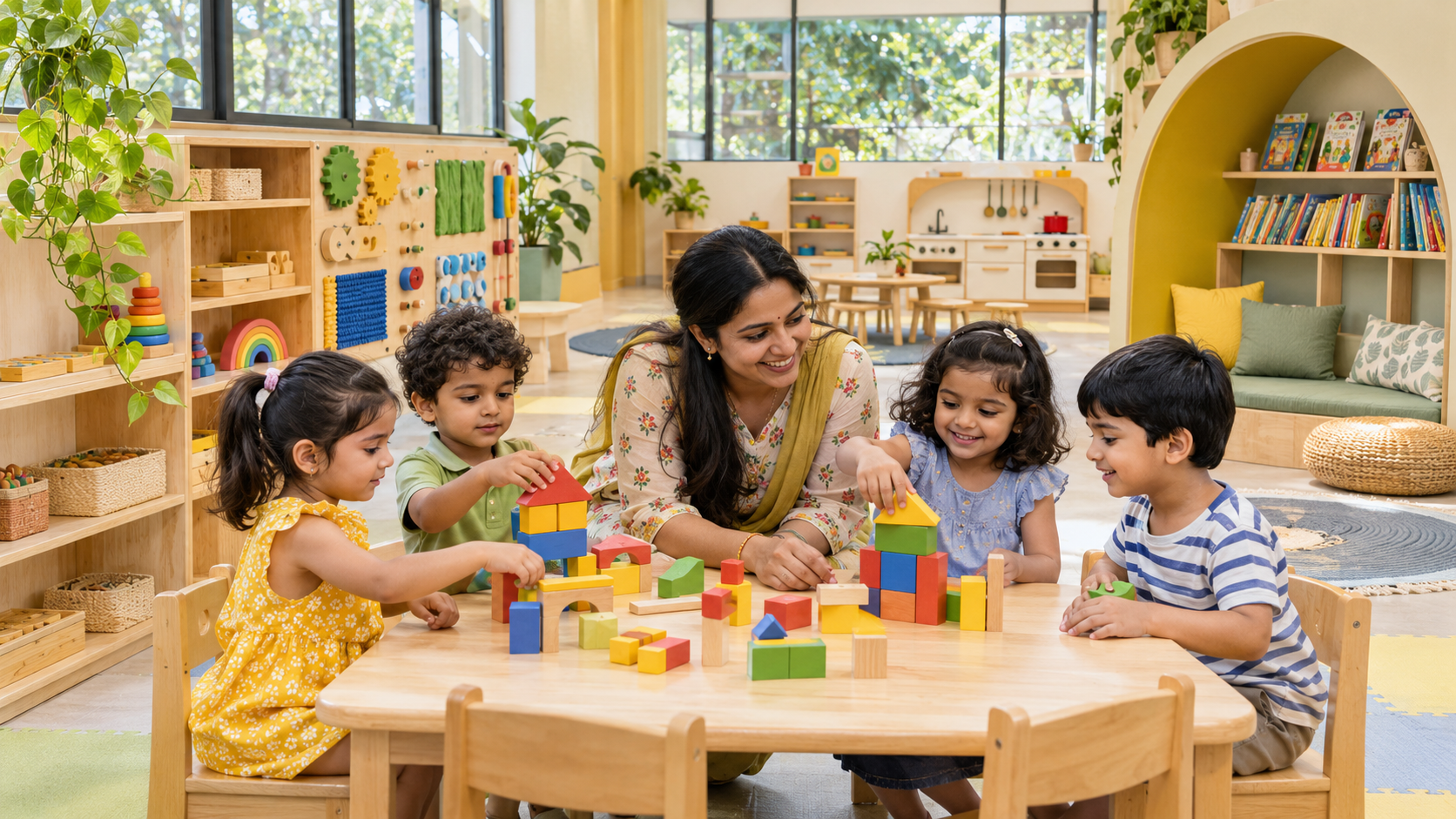
An immersive space is a learning environment built so a child can step inside an idea instead of just hearing about it. A pretend market teaches counting, sharing and conversation all at once. A story nook with soft lighting makes a book feel like an adventure instead of an assignment. These interactive learning spaces differ sharply from a conventional classroom, where information flows in one direction, from teacher to child. In an immersive setup the flow runs every which way: child to material, child to child, child to teacher and back again. Think of it like the difference between reading about the ocean and standing knee-deep in it. Both give you facts, but only one gives you wonder, and wonder is what makes a toddler want to come back tomorrow. Kiddonia’s own materials highlight storytelling, phonics, art, games and hands-on activities as the heart of its day, and spaces designed around those activities make each one feel real. The table below compares the two models side by side.
| Feature | Traditional Classroom | Immersive Learning Space |
|---|---|---|
| Child’s role | Passive listener | Active explorer |
| Learning method | Repetition and worksheets | Play-based learning and discovery |
| Teacher’s role | Instructor | Guide and co-player |
| Senses engaged | Mostly sight and hearing | Touch, movement, sound, sight |
| Motivation | External (marks, stars) | Internal (curiosity, joy) |
| Skills built | Memory | Memory, creativity, social and problem-solving skills |
The Science Behind Play-Based Learning
Is all this play really learning, or are we kidding ourselves? The evidence says it’s real. UNICEF’s June 2026 global data story on play reminds readers of Piaget’s famous line that play is the work of childhood, and it describes play as the main route through which children build physical, social, emotional and cognitive skills. A 2026 scoping review of more than 50 studies on children aged four to six found that play-based learning strengthens cognitive skills, executive function, literacy, mathematics and social-emotional growth. Researchers also point out that the prefrontal cortex, which governs executive function, develops rapidly during the early years, which makes this window precious. Another line of research suggests early development depends less on high-tech tools and more on the rhythm of daily life, with predictable routines and shared play working together. That’s the reassuring bit for parents. A well-designed space with a steady daily rhythm, rich materials and attentive adults beats any gadget. Immersive environments simply give play-based learning the stage it deserves.
How Kiddonia’s Immersive Spaces Support Child Development Activities
Cognitive Growth and Curiosity
When a child walks into a space full of open-ended materials, her brain gets busy before anyone says a word. She sorts blocks by colour, notices that the tall tower falls when the base is narrow, and tries again with a wider foundation. That small loop of guess, test, fail and retry is the engine of early childhood education. Research summarised by early-years educators notes that working memory, cognitive flexibility and impulse control all develop through playful activity. Kiddonia lists cognitive development first among the areas it nurtures, alongside social, emotional, physical and creative growth, and an immersive room makes that goal practical. A pretend kitchen becomes a lesson in sequencing, because first we wash the vegetables, then we chop. A sand tray becomes early science. Because the child chooses the activity, she stays engaged longer, and longer engagement means deeper learning. Parents often notice the result at home as a child who asks “why” ten times a day. Treat that as a win, not a nuisance. It means the child development activities at school are doing exactly what they were designed to do.
Social and Emotional Skills
Picture two four-year-olds who both want the same red truck. In a worksheet classroom, that conflict barely exists. In an immersive space it happens daily, and it’s gold. Shared spaces force children to negotiate, take turns, comfort a friend and cope with the sting of not getting their way. UNICEF’s play report describes play as an emotional training ground where children can safely face defeat, practising feelings they will meet again in real life. Kiddonia stresses a safe, nurturing environment where children feel secure, plus caring educators who encourage participation and confidence. That combination matters, because a child who feels safe is willing to try, and a child who tries builds resilience. Group activities, festivals and functions add another layer, giving shy children a gentle stage and confident children a chance to lead. Parents who visit often tell the school they see changes quickly, such as more sharing, calmer goodbyes and new friendships. Social learning can’t be taught from a book. It has to be lived, and immersive spaces are where little ones live it.
Physical and Sensory Development
Tiny bodies need big movement. Climbing, balancing, squeezing clay, pouring water and threading beads all strengthen the large and small muscles a child will later use to run, write and button a shirt. Kiddonia’s campus information puts sports and fitness front and centre, noting that age-appropriate physical activity helps preschoolers build coordination, balance and teamwork through outdoor play and movement games. Its gallery also features yoga for preschoolers, a lovely way to teach body awareness and calm breathing to young children. Sensory-rich spaces go further by letting children explore texture, sound, light and smell, which helps the brain organise information from the world. Think of the senses as the brain’s input cables; the more varied the input, the stronger the connections. For children who find sensory experiences overwhelming or underwhelming, the school also offers occupational, speech and behavioural therapy services in Wakad, so support sits close to the classroom. A strong preschool activities for kids programme treats the body as part of the mind, never a separate subject.
Language, Phonics and Storytelling
Language doesn’t bloom from flashcards alone. It blooms in conversation, song, rhyme and story. A cosy reading corner invites a child to flip pages, point at pictures and retell a tale in her own words, even if the plot changes with every telling. Kiddonia highlights storytelling and phonics as core activities, and immersive spaces give both a natural home. Imagine a puppet theatre where children act out a story, trying out new words as characters. Or a letter-sound trail where each station connects a sound to an object they can hold. Early educators consistently observe that children in play-rich settings follow instructions better and speak more freely, and the research on executive function explains why. Pretend play asks a child to plan, speak, listen and adapt, all at once. For families worried about speech delays, Kiddonia’s blog and services cover speech therapy for toddlers and children in Wakad, which shows the school takes communication seriously from the first babbled word to full sentences. Reading aloud together, day after day, quietly builds the foundation for school success.
Preschool Activities for Kids That Bring Spaces to Life
Creative Learning for Kids Through Art and Music
Paint on the fingers, glitter on the floor, a song stuck in everybody’s head. That’s creative learning for kids at its messy best. Kiddonia describes its arts and clubs as a place where children express themselves through art, music and creative activities, building imagination and confidence while discovering what they love. In a dedicated creative space, there is no wrong answer. A purple sun is perfectly fine, and the teacher asks “tell me about it” instead of “that’s not right.” Research on play points out that children engage in it for the joy of discovery, mastery and expression, and that this intrinsic motivation is key to lifelong learning. Creativity also builds fine motor skills, patience and problem-solving. When a child mixes blue and yellow and gasps at green, she has just run her first science experiment. Music adds rhythm, memory and emotional release. Over time, children who create freely become adults who think flexibly, so these painting-and-singing hours are far from a break from “real” learning. They’re an investment, and a joyful one.
Experiential Learning for Preschoolers in Action
Experiential learning for preschoolers means learning by doing, then reflecting on what happened. Instead of being told that plants need water, a child waters a seedling, watches it for a week and notices the leaves perk up. Instead of memorising numbers, she sets a table for five friends. An immersive space makes these experiences possible every single day, because the materials are already there, waiting. The teacher’s job shifts from lecturing to observing, asking open questions and extending the play. Scholars describe the ideal as educators who observe and interact to extend play scenarios without taking over. That balance is hard, and it’s what separates a thoughtful play school in Wakad from a room that merely has toys. Experience also sticks. Ask any adult what they remember from childhood and they’ll describe a day trip, a project, a game, never a worksheet. By giving children something to live through, Kiddonia gives them something to remember, and memory is simply learning that lasted.
Programs at a Best-Rated Preschool in Wakad
Choosing a school is easier when you know which door your child will walk through. Kiddonia structures its offering around different ages and family needs, so a two-year-old taking her first steps away from home isn’t grouped with a ten-year-old after-school learner. The homepage lists programs including Pre-School, Day Care, Activity Center and a Summer Camp, with Nursery, Prep I and Prep II also available through the Programs menu. Each one draws on the same philosophy of play-based learning, creativity and holistic development, yet the daily rhythm differs. Working parents in the Wakad, Hinjewadi and PCMC belt often value the extended day care hours, while others prefer a short, gentle preschool session for a first-timer. The school also runs a child therapy section and a shadow teacher training programme, which signals a broader commitment to children with different learning needs. Because schedules and fees can change, treat the table below as a snapshot from the school’s website and confirm current details directly with the admissions team before you decide.
Which Kiddonia Program Fits Your Child?
| Program | Age Group | Timing / Duration |
|---|---|---|
| Pre-School | 2 to 3 years | 2.5 hours |
| Day Care | 1 to 10 years | 9 AM to 7 PM |
| Activity Center | 2 to 10 years | 4 PM to 7 PM |
| Summer Camp | 2 to 5 years | 30 days |
Notice how the Activity Center covers the after-school hours. That’s useful for families who want enrichment, such as art, games and hands-on projects, without a full day-care commitment. The Summer Camp, meanwhile, lets younger children experience the school’s spaces during the holidays, which is a gentle trial run before formal admission. If your child is still adjusting to separation, starting with a shorter session and building up is usually kinder than jumping straight to a full day.
How to Choose a Play School in Wakad
Wakad has plenty of options, so how do you separate the genuinely good from the merely well-advertised? Start with the feel of the place. Walk in and listen. Do you hear children talking, laughing and negotiating, or do you hear a single adult voice and rows of silence? Look at the walls, and ask whether they show children’s own work or only printed posters. Check safety basics, but also check emotional safety: do educators kneel to a child’s eye level and respond warmly? Then look at the spaces themselves. Are there varied zones for stories, building, art, pretend play and movement, and can children reach the materials without asking? A true best preschool in Wakad will show you a rhythm to the day, with predictable routines mixed with plenty of free play, matching what the latest research says about brain development. Finally, consider the partnership. Kiddonia highlights regular parent communication as a pillar of its approach, which matters, because the strongest learning happens when school and home pull in the same direction instead of two.
Questions to Ask During Your School Visit
Visits go better with a short list. Ask how a typical day flows from arrival to pick-up, and how much of it is free exploration versus guided activity. Ask what the teacher does when two children disagree, because the answer reveals the school’s whole philosophy. Ask how progress is shared with parents, how often, and in what form. Ask what support exists for a child who is shy, slow to speak, or especially energetic, since every classroom has all three. Ask about staff training and how long educators have been with the school; Kiddonia traces its journey back to 2009, which suggests long experience in the Pune region. Finally, ask to see the spaces in use, not just a spotless empty room. Kiddonia says parents can contact the school to enquire about programs and schedule a visit, and that is the best thing you can do. Photos help, reviews help, but nothing replaces watching your own child’s face when she walks in. Trust that reaction; children are brilliant at sensing where they belong.
Extending the Learning Journey at Home
School is only one chapter of the story. The good news is that you don’t need a fancy playroom to carry immersive learning home. A cardboard box becomes a spaceship, a laundry basket becomes a boat, and a kitchen cabinet of pots and spoons becomes an orchestra. Research on parent-child play suggests that shared play helps align parent and child behaviour and strengthens their emotional connection, so even ten unhurried minutes of floor time counts. Follow your child’s lead. If she’s obsessed with ladybirds, borrow a picture book, hunt for them in the garden, draw them together, and count their spots. Keep a steady daily rhythm too, with regular meals, stories and bedtimes, because children thrive on predictability. Ask your child’s teacher what theme or sound the class is exploring, then echo it in simple ways. And please, resist the urge to turn every play session into a quiz. When you play, simply play. Your child will absorb more from your delighted attention than from any flashcard. That consistency between home and school is what turns good early childhood education into lasting confidence.
Conclusion
Immersive spaces aren’t a decoration; they’re a method. At Kiddonia Preschool in Wakad, they put interactive learning spaces, play-based learning and thoughtful educators together so children can think, move, create and connect every day. The research backs the approach, linking play to stronger executive function, language, social-emotional skills and early academic learning, while Kiddonia’s range of programs, from Pre-School to Day Care and the Activity Center, gives families real flexibility. Whether you’re comparing a play school in Wakad for a two-year-old or planning an enrichment option for an older child, the smartest next step is simple. Visit, observe, and watch how your child responds. If she’s absorbed, smiling and curious, you’ve probably found the right place. Reach out to Kiddonia through its contact page to book a visit and see the spaces in action.
FAQs
1. What makes the immersive spaces at Kiddonia different from a regular classroom?
They’re designed around exploration instead of listening. Children move between story, art, movement and pretend-play areas, using real materials to learn through experiential learning for preschoolers, while educators guide and extend the play.
2. Is play-based learning enough to prepare my child for primary school?
Research reviews link play-based approaches to stronger literacy, mathematics, executive function and social-emotional skills. Kiddonia also includes phonics and storytelling, so children build school-readiness within a playful routine.
3. What age groups can join Kiddonia’s programs in Wakad?
Per the school’s website, Pre-School takes children aged 2 to 3, Day Care covers 1 to 10 years, the Activity Center covers 2 to 10 years, and Summer Camp covers 2 to 5. Confirm current details with the school.
4. Does Kiddonia support children who need extra developmental help?
The school lists child developmental therapy, including speech, occupational and behavioural services, and a shadow teacher training programme in Wakad. Contact the team to discuss your child’s specific needs.
5. Can I visit before taking admission?
Yes. Kiddonia states that parents can contact the school, ask about programs and schedule a visit to see the learning environment and facilities first-hand.