Discover how clay modelling in early childhood builds fine motor skills, problem-solving and language, with safe activity ideas from a Wakad, Pune play school.
Table of Contents
Why Clay Deserves a Place in Every Preschool
Hand a toddler a lump of clay and watch what happens. First she pokes it. Then she squeezes it, sniffs it, flattens it with her palm and announces, with total confidence, that it’s a cake. In about two minutes she has run a small science experiment, practised a dozen hand movements and started a story.
That is why clay modelling in early childhood is far more than an art-table filler. Clay is a “loose” material: it has no instructions, no right answer and no screen telling the child what to do next. Everything that happens comes from the child’s own thinking, and in a world where little ones swipe before they can speak in sentences, a material that pushes back against their fingers feels almost radical.
For parents searching for the best preschool in Wakad, hands-on materials like clay are a good sign that a school understands how young brains learn. This article explains the science, the skills and the simple ways to use clay well, at school and at home. You can also read how play-based learning shapes the day at Kiddonia.
What the Research Says About Clay and the Developing Brain
Fine Motor Skills and the Brain Connection
Fine motor skills are the small, precise movements of the fingers, hands and wrists that eventually let a child hold a pencil, fasten a button and cut with scissors. Educators describe them as the foundation for school readiness, independence in self-care and overall confidence. Clay is one of the best natural trainers for these muscles, because squeezing, pushing, pulling, pinching and pressing malleable materials strengthens the small muscles of the hands and fingers.
Pinching off a little piece builds the pincer grasp. Holding the clay in one hand and shaping with the other teaches both hands to work as a team, a skill called bilateral coordination that a child needs later to steady paper while she writes.
Here’s the part many adults miss: hand control and brain control grow together. The movements a child practises with her fingers feed the brain regions that plan, sequence and focus. When your three-year-old patiently rolls a snake of clay, she isn’t just playing. She’s preparing for the classroom ahead.
Evidence From Playdough and Clay Studies
How strong is the evidence? It’s encouraging, though it deserves honest caution. A quasi-experimental study from Universiti Malaysia Sabah followed one group of preschoolers and found that average fine motor scores rose from about 60.5% to 89.9%, while cognitive scores rose from about 66.5% to 95.2%. A 2022 study in the International Journal of Early Childhood Learning reported that playdough games cut the share of children with poor fine motor development by 20.6% and raised understanding of symbols, numbers and letters by an average of 37.25%.
Both studies were small and lacked comparison groups, so they show a promising link and not a guaranteed result.
Practitioner evidence adds colour. In a Froebel Trust-funded project, Edinburgh nurseries worked with a clay specialist and found that children who didn’t readily explore writing materials developed similar fine motor skills through clay. The honest summary is simple: clay is cheap, safe when chosen well, and consistently linked with better hand skills and early learning.
Cognitive Skills That Clay Modelling Builds
Problem-Solving, Memory and Focus
Every clay creation is a tiny engineering project. A child imagines a dinosaur, discovers its legs keep collapsing, and tries again with thicker legs. That loop of plan, test, fail and adjust is executive function in action, and neuroscientists note that the prefrontal cortex, which governs these skills, develops rapidly during the early years.
Clay trains memory, too. To rebuild yesterday’s elephant, a child has to remember its trunk and the way she attached the ears. It trains focus as well, because shaping something small demands sustained attention that flashing screens rarely ask for. A four-year-old absorbed in her own idea may stay at the clay table for fifteen minutes or more.
Because clay is forgiving, mistakes cost nothing. Squash it, reshape it, start again. That safe practice at failing builds a resilient, curious learner, exactly what play-based learning aims to produce.
Early Maths and Spatial Thinking
Clay quietly teaches maths long before a child meets a number line. Splitting a ball into two equal pieces introduces fractions. Making five little cakes and handing three to a friend practises counting, subtracting and sharing. Rolling a ball and flattening it into a disc shows that the same amount of clay can take different shapes, an idea children usually grasp between ages four and seven.
Words like “bigger”, “longer” and “thicker” build mathematical vocabulary naturally. Spatial thinking grows as children work out how a tall tower balances or how a bridge spans a gap.
Teachers and parents can stretch the learning with open questions: “How many legs will your spider need?” or “Can you make a snake longer than your hand?” This is experiential learning for preschoolers at its simplest and most effective.
Language, Storytelling and Pre-Writing
Clay creations are never silent. Ask a child about her lump and you’ll often get a whole story about who lives in the house and why the snake is sad. That talk builds vocabulary (“squishy”, “smooth”, “bumpy”), sentence structure and the ability to put thoughts in order. The Edinburgh practitioners noticed that children described their clay work much as others describe their drawings, so clay can be a genuine storytelling medium.
Clay also prepares the hand for writing. Rolling thin snakes helps children form lines and curves, and pressing a stick into a clay slab lets them make marks. Some teachers invite children to roll the first letter of their name in clay before they ever hold a pencil.
Pairing clay with a storybook works well: read about a bear, then model its cave. Kiddonia highlights storytelling, phonics and hands-on activities in its daily programme, and clay connects the hand, the voice and the imagination.
Emotional and Social Benefits of Clay Play
Cognitive growth is only half the story. Clay is also soothing. The cool, yielding feel calms busy hands, and many children who struggle to sit still will happily pound, roll and squeeze, then emerge visibly calmer. Pushing hard on clay gives the body strong, grounding feedback, which is why occupational therapists often use resistance play to help children regulate their energy.
Clay also gives big feelings a safe outlet. A frustrated child can thump a lump of clay without hurting anyone, and a proud child can show off her creation with a shining face. UNICEF’s June 2026 report on play describes it as a space where children can safely face defeat and practise emotions they’ll meet again later.
Socially, a shared table of clay encourages negotiation and turn-taking. Two children building a clay zoo must agree who makes the lion and who gets the last bit of green. These preschool activities for kids build confidence, patience and empathy that show up later in the playground.
Age-Wise Clay Activities for Preschoolers
Ages 2 to 3: Squish, Poke and Roll
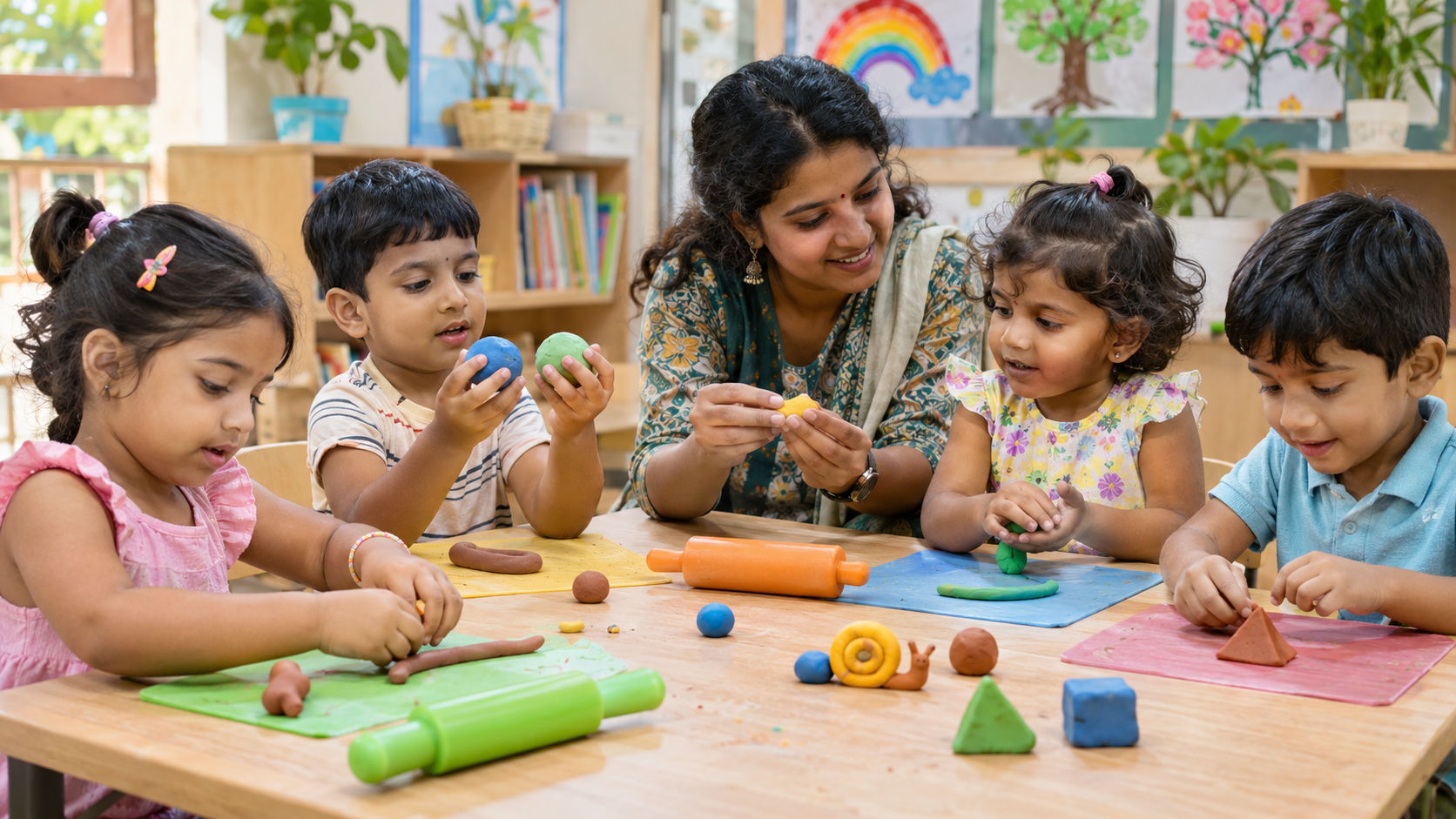
For two- and three-year-olds, clay is about sensation and cause and effect. Offer a golf-ball-sized lump of soft dough and let her explore without asking her to make anything. Show her how to poke with one finger, roll between both palms, pinch off tiny bits and press a flat hand to make a print. Add one prop at a time, such as a wooden spoon or a large cookie cutter.
Expect the clay to be tasted, dropped and squashed on the floor, so stay close. Five to ten minutes is plenty. Narrate in simple, rich words: “you’re squeezing, it’s squishy, now it’s flat.” That commentary is language gold.
Kiddonia’s Pre-School programme welcomes children aged 2 to 3 for 2.5-hour sessions, a gentle length that suits this age group.
Ages 4 to 5: Build, Count and Tell Stories
By four and five, children are ready to plan, build and narrate. Offer a bigger lump, a few tools such as craft sticks and pattern stamps, and a loose theme like “a house for an animal”. Encourage her to decide first, create second and explain third. Ask “what’s your plan?” and “how could we make it stand up?”
Add number games by asking for seven berries or three snakes of different lengths. Let two or three children build a clay village together, which grows teamwork. Older preschoolers can roll the first letter of their name or copy a pattern of coloured balls, a lovely bridge to reading and writing.
| Age | Activity | Skills Practised |
|---|---|---|
| 2 to 3 years | Poke, pinch, roll and print | Hand strength, sensory exploration, vocabulary |
| 3 to 4 years | Snakes, balls and simple “food” | Pincer grasp, counting, pretend play |
| 4 to 5 years | Animal houses, letter rolling, shared villages | Planning, early maths, storytelling, teamwork |
| 5 years and above | Pinch pots, patterns, story scenes | Fine control, sequencing, creative expression |
Safety, Materials and Choosing the Right Clay
Picking Child-Safe Clay
Not every clay suits small hands. For toddlers, soft non-toxic playdough or homemade salt dough is the safest start, since children this age explore with their mouths. Older preschoolers can use air-dry clay or good-quality non-toxic modelling clay, which hold their shape better.
Always look for labels that state the product is non-toxic and age-appropriate, and avoid clays with strong smells or unclear ingredients. Wash hands before and after play, wipe dropped pieces off the floor to prevent slips, and store clay in airtight containers to keep it soft and mould-free.
Watch for allergies, especially with homemade dough containing wheat, and keep small tools and beads away from children who still mouth objects. Supervise closely at all times.
| Clay Type | Best For | Things to Watch |
|---|---|---|
| Playdough (shop-bought) | Ages 2 and above | Check non-toxic label and allergens |
| Homemade salt dough | Toddlers, home play | Very salty, so discourage tasting; contains wheat |
| Air-dry clay | Ages 4 and above | Dries out quickly; keep covered |
| Non-toxic modelling clay | Ages 4 and above | Firmer, so may tire small hands |
When to Talk to a Specialist
Clay play can reveal a lot about your child, but it can’t diagnose anything. Every child grows at her own pace, and some clumsiness at three is normal. Still, speak with your paediatrician or an occupational therapist if your child strongly avoids messy textures, can’t grip or squeeze, seems unusually weak in the hands, or is far behind peers in using her fingers by age four or five.
Early support makes a real difference, and asking is simply a sign of care. Note a few specific examples before the appointment, such as what she finds hard and when, because concrete observations help specialists far more than general worries.
Kiddonia lists child developmental therapy services in Wakad, including occupational, speech and behavioural support. This article is general information and can’t replace advice from a qualified professional who has met your child.
How a Play School in Wakad Can Use Clay in Play-Based Learning
A good play school in Wakad doesn’t treat clay as a Friday craft. It weaves clay through the week around a theme such as “my neighbourhood”. On Monday children read a story and model their own house. On Tuesday they roll clay vegetables for a pretend market. On Wednesday they count and swap them, on Thursday they build a shared street, and by Friday they tell visitors what happens there.
Each day uses the same material for a different purpose, and each builds on the last. That’s the heart of play-based learning: open materials, a clear theme and a teacher who asks good questions without taking over.
Kiddonia describes its approach as play-based and activity-based, with art, storytelling and creative clubs, and its Activity Center welcomes children aged 2 to 10 from 4 PM to 7 PM. [Add a real observation here: a short example of a Kiddonia teacher seeing a child’s skills grow through clay, with the teacher’s name and role.] If clay matters to you, ask the school how often children use it and how teachers record progress.
Clay Modelling at Home: A Parent’s Guide
You don’t need a studio. A tray, a tablecloth and a bit of patience are enough. Set up a small clay corner at the kitchen table with a cookie sheet to catch crumbs, a few safe tools and a damp cloth. Start with ten minutes and let your child lead. Resist the urge to correct her, and don’t turn it into a test. Instead, describe what she’s doing and ask: “Tell me about your creature.”
Join in at her level and make something silly beside her, because shared play deepens your bond. Research suggests that shared play helps align parent and child behaviour and strengthens emotional connection.
Link clay to everyday life by shaping characters from a favourite book, rolling pretend chapatis or modelling a family portrait. Keep a small tub in your bag for restaurant waits. The finished product isn’t the point. The squashing, rolling and chatting are the learning, and a lopsided clay giraffe made by a proud three-year-old is a small masterpiece.
Conclusion
Clay modelling in early childhood builds far more than pretty pots. It strengthens the small muscles that prepare children for writing, trains planning, memory and focus, introduces early maths, feeds language and storytelling, and gives big feelings a safe place to land. The research is promising though modest in size, and practitioners consistently report more confident, capable thinkers.
Choose child-safe materials, keep sessions short and playful, and let your child lead. If you’re comparing options for a play school in Wakad, look for classrooms where hands-on materials like clay are part of the daily rhythm. Kiddonia Preschool welcomes enquiries and visits through its contact page, so you can see the learning environment first-hand. Pick up a lump of clay tonight, sit down with your little one and see what you create together.
FAQs
1. At what age can children start clay modelling?
Most children can begin exploring soft, non-toxic playdough around age two under close supervision. Air-dry and modelling clay suit ages four and above, since firmer clay needs more hand strength.
2. How does clay modelling improve cognitive development?
Clay asks children to plan, test ideas, remember shapes, count, compare sizes and describe what they’ve made. Those mental steps build executive function, early maths and language, alongside fine motor skills.
3. Is clay better than playdough for preschoolers?
Neither is “better”. Playdough is softer and safer for toddlers, while clay gives older children more resistance and detail. A mix of both across the year offers the widest range of experiences.
4. How long should a clay session last for a preschooler?
Five to ten minutes suits two- and three-year-olds, and ten to twenty minutes works for four- and five-year-olds. Follow your child’s interest and stop when focus fades, so clay stays fun.
5. When should I worry about my child’s hand skills?
Talk to a paediatrician or occupational therapist if your child avoids messy textures, can’t grip or squeeze, or is well behind peers in using her fingers by age four or five.